

Operations
Restaurants Cannot Control Inflation. They Can Control This
Restaurants cannot control the wider market. They can control how quickly they adapt to it. That is why menu workflow matters more than it once did.
15 April 2026
Restaurants cannot control inflation, labour pressure, supplier volatility, or the wider mood of economic uncertainty. What they can control is how quickly they respond.
That matters more than it used to.
Last year, 42% of restaurant operators in the US said their business was not profitable. In that kind of environment, even small sources of friction start to matter.[1]
Menus are increasingly tied to operational guile
For many operators, the menu was never the main event. The food was. The service was. The menu was something you refreshed occasionally — a price update here, a reprint there, perhaps a broader redesign once in a while.
That feels less realistic now.
Even before this latest global economic uncertainty, in Australia, meals out and takeaway food prices rose 3.7% in the 12 months to February 2026.[2] In the UK, food and non-alcoholic beverage prices rose 4.5% in the 12 months to December 2025.[4] Markets differ, of course, but the pattern is familiar: costs move, and menus cannot stay static for long.
Menus sit right at the intersection of pricing, availability, promotions, and guest communication. When those things change faster than the menu does, the menu can start to work against the business rather than for it.
Why flexibility matters more than perfection
Canada’s Food Price Report 2026 says food prices are now 27% higher than they were five years ago.[3] That kind of longer-term pressure changes how operators think about everyday decisions, including pricing, promotions, substitutions, and how often menus need to evolve.
In that kind of environment, it’s an unfortunate reality that flexibility must do battle with the ideals we want for our customers.
A restaurant does not always need a grand redesign. It may simply need to update quickly, keep formats aligned, and avoid the slow admin cycle that turns simple menu changes into a bigger task than they should be.
The hidden drag in traditional menu production
The administration of a menu update often sounds simple until the work begins.
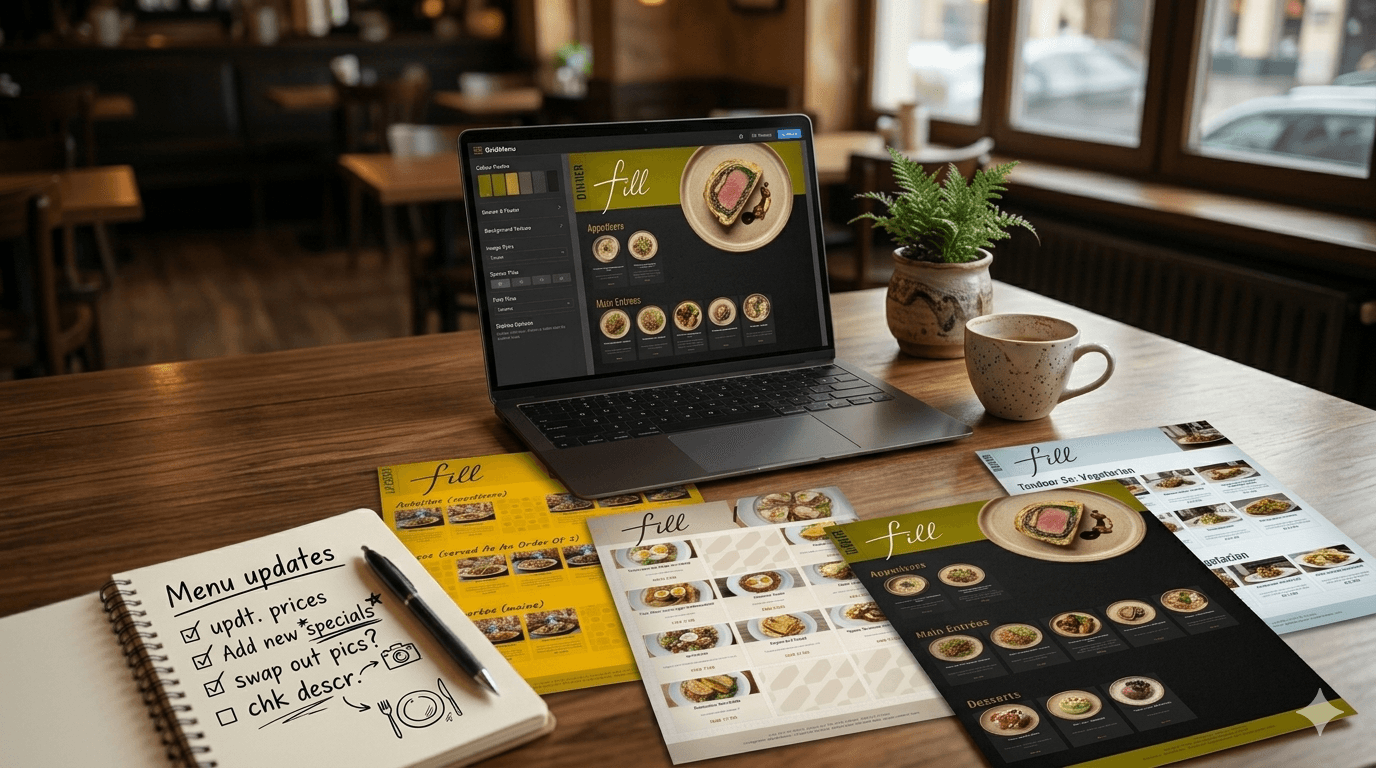
Someone has to update the copy. Someone has to handle layout. Someone has to check prices. Someone has to produce files for print. If photos are needed, someone has to prepare the dishes and someone has to shoot them. Then there is the delay of reprinting, replacing worn copies, or simply living with inaccuracies until the next update cycle.
None of this is catastrophic by itself. But it adds up — and it tends to land on whoever already has the least spare time.
The goal is to make menu creation and updating less brittle.
A quieter, more honest benefit
There are certainly cost savings here, yes. But that is probably not the only way to frame it.
No menu platform is going to solve the wider economic pressures facing hospitality. It is not going to fix inflation, labour shortages, or supplier instability. Yet it can be made more friendly to the balance sheet, and removes one avoidable source of friction. That is where a menu creation tool like GridMenu quietly pays for itself.
Its a modest claim. But in a difficult market, modest gains are still useful.
Less coordinating providers. Fewer version-control problems. Faster updates. Less lag between deciding on a change and seeing it reflected in the menu.
That is not a miracle. It is just operationally helpful.
Final thought
Restaurants cannot control the wider market.
They can control how quickly they adapt to it.
That is why menu workflow matters more than it once did. Not because it is the single biggest issue in hospitality, but because it touches pricing, communication, operations, and presentation all at once.
A better workflow will not fix everything. It may, however, make one important part of the job simpler, faster, and easier to keep current — and give you a little more headspace for the parts of the job you actually got into this for.
And right now, that is valuable enough.